Every article about SEO seems to say something different, and it gets confusing fast. One post says backlinks are everything. Another says content is all that matters. This post clears up the noise and separates fact from myth, one at a time.
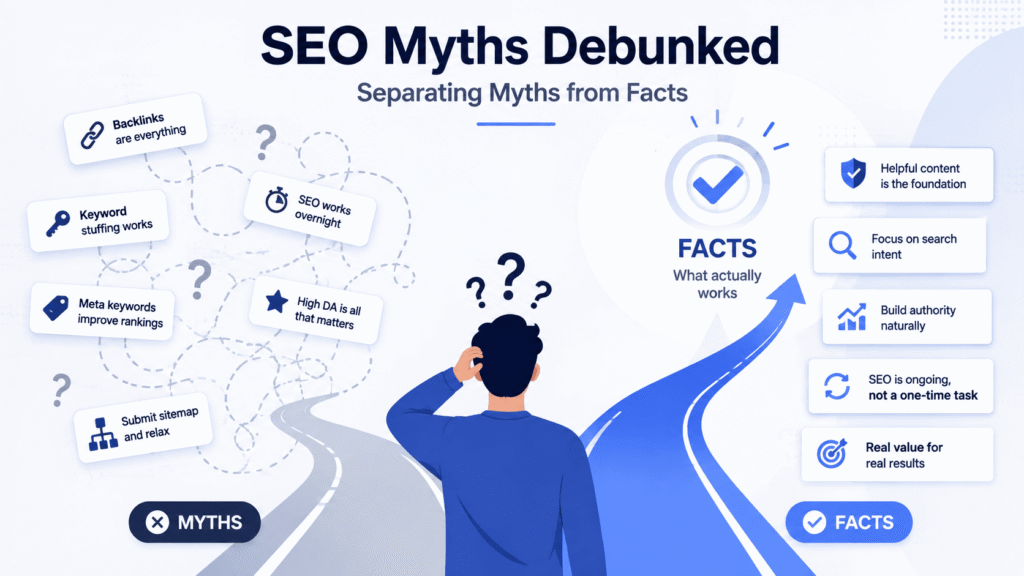
Why Do So Many SEO Myths Exist?
| Term | Meaning |
| SEO Myth | An SEO myth is a piece of advice that used to be true, was never true, or gets repeated so often that people assume it is a fact. |
SEO has been around for a long time, and it changes constantly. Google updates how it ranks websites all the time, but old advice does not disappear from the internet. It just keeps getting repeated.
Beginners often pick up advice from outdated blog posts, old YouTube videos, or friends who tried SEO years ago and never checked if their information was still accurate. Some myths also come from half-truths. A tactic might have worked once, under very specific conditions, and somewhere along the way it turned into a general rule.
None of this is anyone’s fault. It just means beginners need a clear, honest breakdown of what actually matters. That is exactly what this post provides.
Myth – SEO Is a One-Time Task
| Term | Meaning |
| Ongoing SEO | Ongoing SEO means continuing to improve, update, and maintain a website’s content and structure over time, rather than doing it once and stopping. |
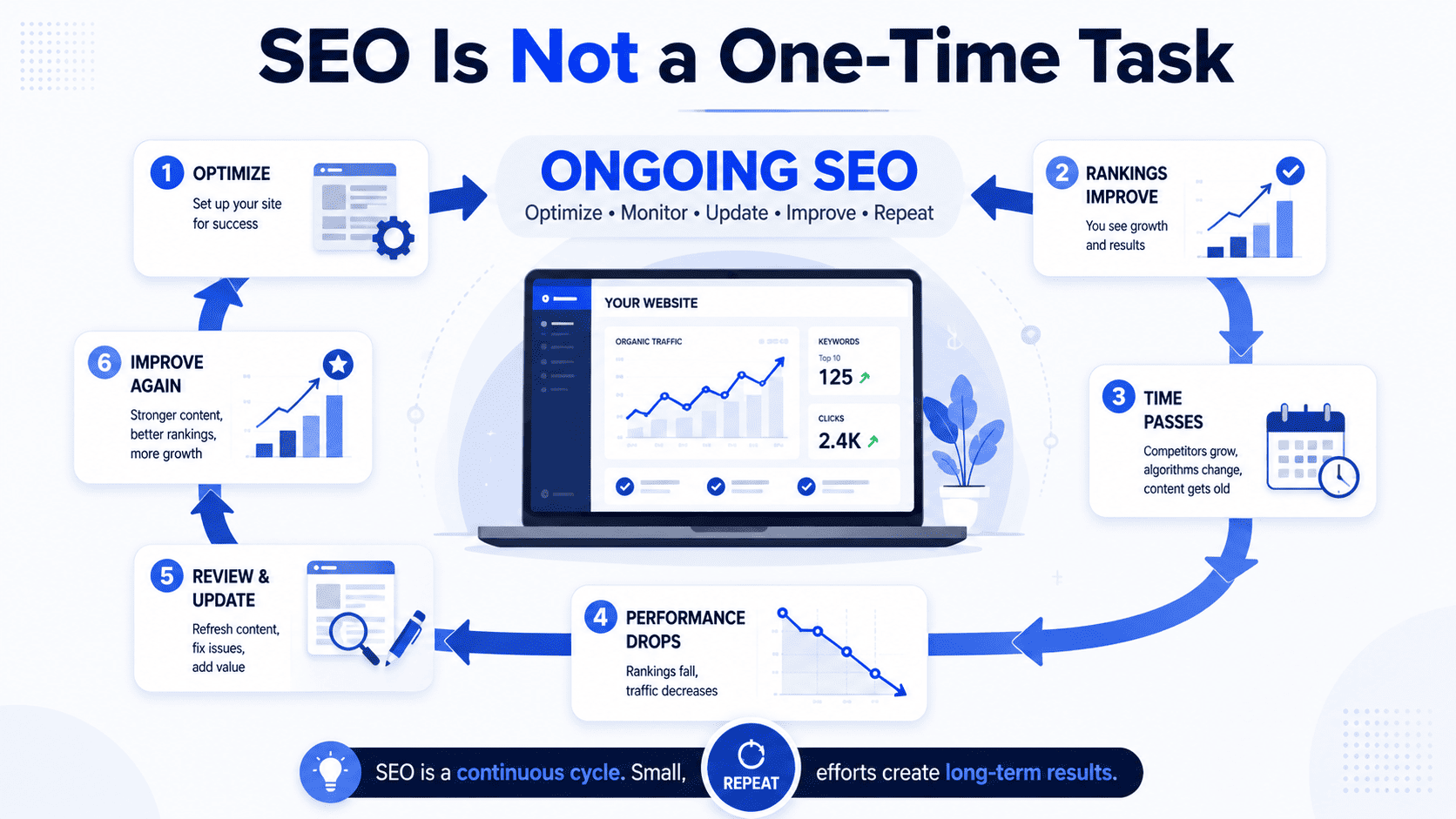
Many beginners believe that once a website is set up correctly, the job is done. That is not how SEO works. Google constantly reevaluates websites, and competitors keep publishing new content too.
A blog post that ranks well today might slip in rankings months later if nobody updates it. Search intent shifts, new competitors appear, and Google’s algorithm keeps evolving. Treating SEO as a one-time project sets a blog up to lose the progress it worked hard to gain.
The good news is that ongoing SEO does not mean constant work. A quick review every few months, along with fresh content added regularly, keeps a website in good shape.
Myth – More Keywords Always Mean Better Rankings
| Term | Meaning |
| Keyword Stuffing | Keyword stuffing means repeating a keyword so many times in a piece of content that it sounds unnatural and hard to read. |
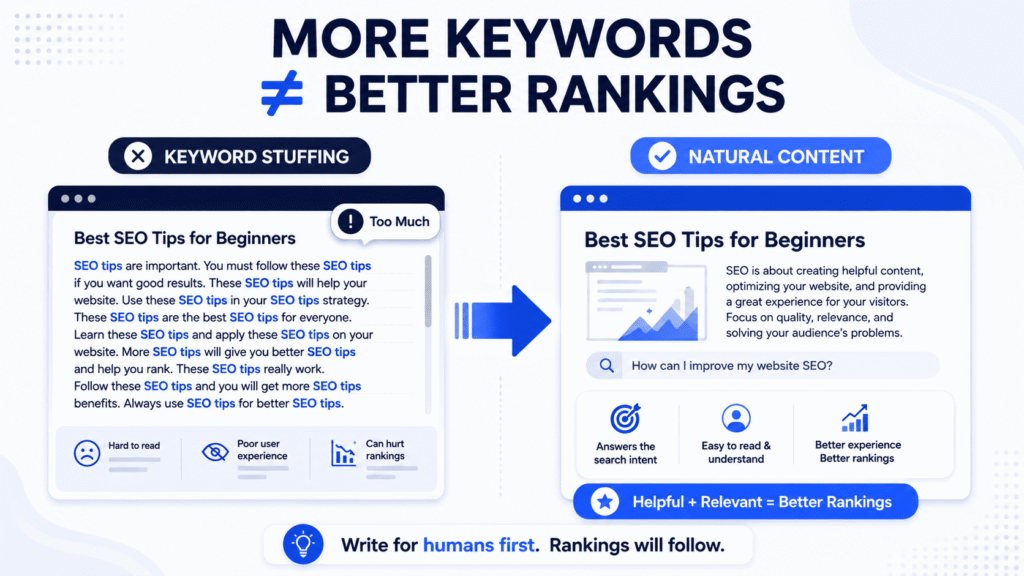
This myth has been around for a long time. Older SEO strategies really did reward stuffing a page with keywords, so it makes sense that the idea stuck around.
Google no longer works that way. Modern ranking systems focus on whether content actually answers the reader’s question, not how many times a phrase gets repeated. Stuffing keywords into a post today can actually hurt rankings, since it makes content harder to read and signals low quality.
A much better approach is writing naturally and letting the keyword appear where it makes sense. This ties directly into on-page SEO, which covers how titles, headers, and content placement affect rankings.
That connects to how keyword placement actually works, which explains this in more detail.
Myth – Domain Authority Is the Only Thing That Matters
| Term | Meaning |
| Domain Authority | Domain authority is a third-party score that estimates how likely a website is to rank in search results, based on factors like its backlinks and age. |
Many beginners obsess over their domain authority score, checking it constantly and feeling discouraged when it stays low. Here’s the thing: domain authority is not something Google actually uses to rank websites.
It was created by a third-party SEO tool as a helpful estimate, not an official Google metric. A brand-new blog can still outrank an older, higher-authority site if its content answers the reader’s question better.
Focusing entirely on this one number distracts from the things that genuinely move the needle, like content quality and search intent. It helps to understand whether domain authority actually matters before spending too much energy trying to increase it.
Myth – Backlinks Are the Fastest Way to Rank
| Term | Meaning |
| Backlink | A backlink is a link from another website pointing to a page on a different website, which can signal trust to search engines. |
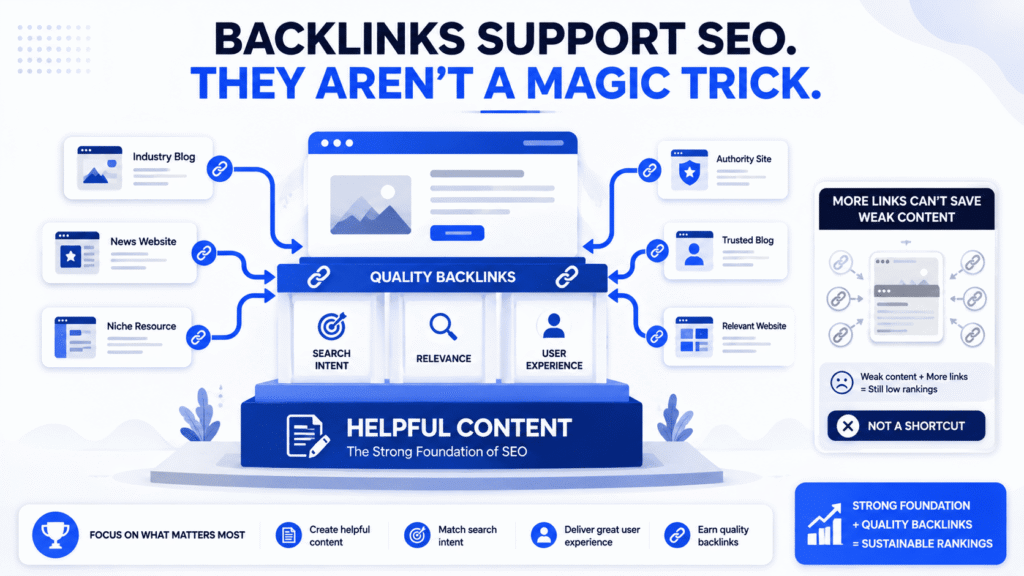
Backlinks matter, but treating them as a shortcut leads to disappointment. Building backlinks takes time, and low-quality or spammy backlinks can actually cause more harm than good.
New websites especially need to be careful here. Chasing backlinks aggressively before a site has solid content in place rarely works, and it can waste a lot of effort. Content quality and relevance still come first. Backlinks work best as a supporting factor, not a magic trick.
Anyone ready to start building backlinks the right way should look at link building for beginners, which breaks the process down step by step.
Myth – SEO Works Overnight
| Term | Meaning |
| SEO Timeline | An SEO timeline refers to the realistic amount of time it takes for a website to start seeing noticeable results in search rankings |
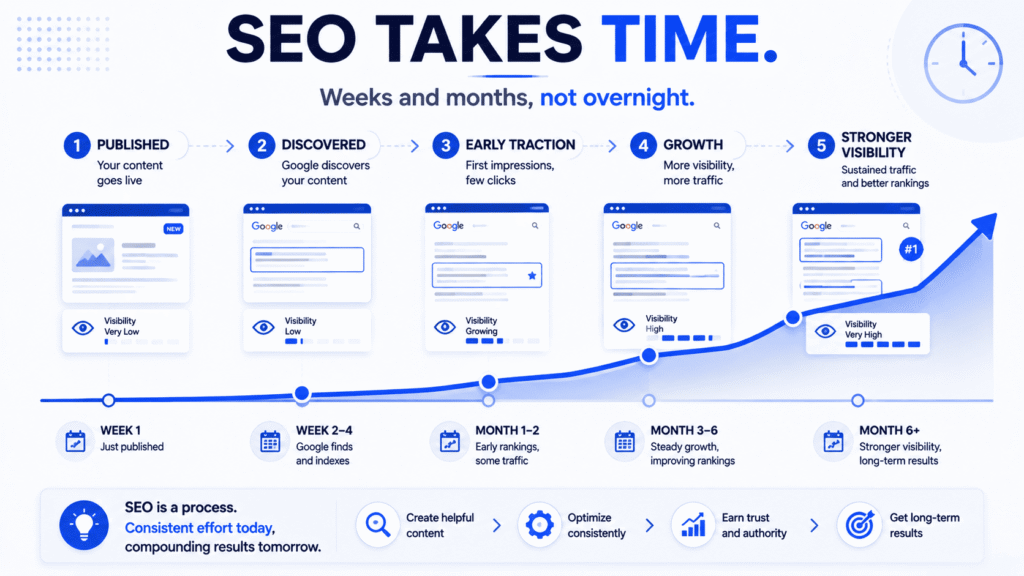
This might be the most common myth of all, and it causes a lot of beginners to give up too early. SEO is not instant. Even a perfectly optimized post usually takes weeks or months to gain traction, since Google needs time to notice, evaluate, and rank new content.
Expecting fast results leads to frustration and, often, abandoning good strategies before they have a real chance to work. Patience is part of the process, not a sign that something is going wrong.
For an honest breakdown of what to expect, check out how long does SEO take, which walks through realistic timelines.
Myth – You Need to Pay for Tools to Do SEO
| Term | Meaning |
| Free SEO Tools | Free SEO tools are tools that provide useful ranking, traffic, or keyword data at no cost, often with fewer features than paid versions. |
Expensive SEO tools can feel intimidating, especially for someone just starting out. The good news is that plenty of free options exist, and they are more than enough for a beginner blog.
Google Search Console, for example, shows exactly how a website performs in search results, completely free. It tracks clicks, impressions, and which keywords bring in visitors. Paid tools can offer more advanced features later, but nobody needs to spend money to start doing SEO properly.
Myth – The Meta Keywords Tag Helps You Rank
| Term | Meaning |
| Meta Keywords Tag | The meta keywords tag is an old HTML tag that once let website owners list keywords for search engines, but it no longer affects rankings. |
This myth comes from genuinely old advice. Search engines used to read the meta keywords tag to understand what a page was about. That stopped being true a long time ago.
Major search engines now ignore this tag completely when deciding rankings. Spending time filling it out is not harmful, but it also does nothing helpful. Energy is much better spent on the title tag, meta description, and actual content quality.
Myth – You Must Submit Your Site to Google Every Day
| Term | Meaning |
| Site Submission | Site submission means telling Google that a website or page exists, usually done once through a sitemap rather than repeatedly. |
Some beginners believe they need to manually resubmit their website to Google constantly for it to stay indexed. That is not accurate. Google regularly crawls the web on its own and revisits websites automatically.
Submitting a sitemap once, through Google Search Console, helps Google discover pages faster, especially for a new site. After that, Google continues checking for updates on its own schedule. Anyone unsure how to do this the right way should look at how to submit your sitemap to Google.
Myth – SEO Is Dead Because of AI Search
| Term | Meaning |
| AI Search | AI search refers to search experiences that use artificial intelligence to summarize or generate answers, in addition to traditional search results. |
This myth pops up whenever search technology changes. The truth is simpler than it sounds. AI search still relies on well-written, trustworthy content to pull information from, which means good SEO fundamentals still matter.
Search behavior is shifting, and paying attention to those shifts is smart. But shifting is very different from disappearing. Websites that focus on genuinely helpful, well-organized content tend to do fine no matter how search results are displayed.
Myth – Duplicate Content Always Gets You Penalized
| Term | Meaning |
| Duplicate Content | Duplicate content refers to identical or very similar text that appears on more than one page, either on the same website or across different websites. |
The word “penalty” makes this myth sound scarier than it actually is. In most cases, Google does not punish a website for duplicate content. Instead, it simply chooses one version to show in search results and mostly ignores the rest.
Real penalties usually only happen when duplicate content looks intentionally deceptive or spammy, which is rare for genuine beginner blogs. Still, writing original content is always the better approach, since duplicate pages compete with each other for the same rankings instead of working together.
Myth – You Must Publish Every Day to Rank
| Term | Meaning |
| Publishing Consistency | Publishing consistency means maintaining a steady, realistic schedule for posting new content, rather than posting as often as possible. |
Daily publishing sounds impressive, but it is not a requirement for ranking well. What actually matters is consistency and quality. A blog that publishes one well-researched post per week will usually outperform a blog that rushes out low-quality posts daily.
Quality drops fast when content gets rushed just to hit a schedule. A realistic, sustainable publishing pace protects both quality and motivation, which matters a lot for anyone building a blog long term.
Myth – Guest Posting Doesn’t Work Anymore
| Term | Meaning |
| Guest Posting | Guest posting means writing an article for someone else’s website, usually in exchange for a backlink or exposure to a new audience. |
Guest posting got a bad reputation because it used to be abused for spammy backlinks. That does not mean the strategy stopped working. Done correctly, on relevant, quality websites, guest posting still helps build backlinks and reach new readers.
The key difference is quality over quantity. Writing one genuinely useful guest post for a relevant website beats submitting dozens of low-effort posts anywhere that will accept them. This connects closely with link building for beginners, since guest posting is one of the more approachable ways to start.
Myth – Longer Content Always Ranks Better
| Term | Meaning |
| Search Intent Match | Search intent match means the content actually answers what the searcher is looking for, regardless of how long or short it is. |
Long articles can rank well, but length alone is not the reason. What actually matters is whether the content matches search intent, meaning it gives the reader exactly what they were searching for.
A short, focused answer can easily outrank a long, padded article if it solves the reader’s problem faster. Adding extra length just to look thorough often hurts readability instead of helping rankings. Anyone wanting to understand this better should read what search intent is and why it changes everything.
Myth – Bounce Rate Directly Affects Rankings
| Term | Meaning |
| Bounce Rate | Bounce rate is the percentage of visitors who leave a website after viewing only one page. |
Bounce rate gets blamed for a lot of ranking drops, but Google has stated it does not use bounce rate as a direct ranking factor. A high bounce rate is not automatically bad. Sometimes a visitor finds their answer quickly and leaves satisfied, which is actually a good outcome.
That said, bounce rate can still be a useful signal for a website owner. If visitors consistently leave within seconds, it might mean the content is not delivering what they expected. Treating it as feedback, rather than a ranking penalty, is the healthier approach.
Myth – You Need an Expensive Agency to Rank
| Term | Meaning |
| SEO Agency | An SEO agency is a company that manages SEO strategy and tasks on behalf of a website owner, usually for a monthly fee. |
Hiring an agency can help, especially for larger businesses with complex needs. But it is not a requirement for a beginner blog to succeed. Plenty of successful blogs are run entirely by one person, using free tools and consistent effort.
SEO fundamentals, like writing helpful content, understanding keywords, and fixing basic technical issues, are learnable by anyone. Starting without an agency also means learning the process firsthand, which builds skills that last long after any single blog post.
Myth – Once You Rank #1, You Stay There Forever
| Term | Meaning |
| Ranking Fluctuation | Ranking fluctuation refers to normal changes in a page’s search position over time, caused by algorithm updates, competitors, or content changes. |
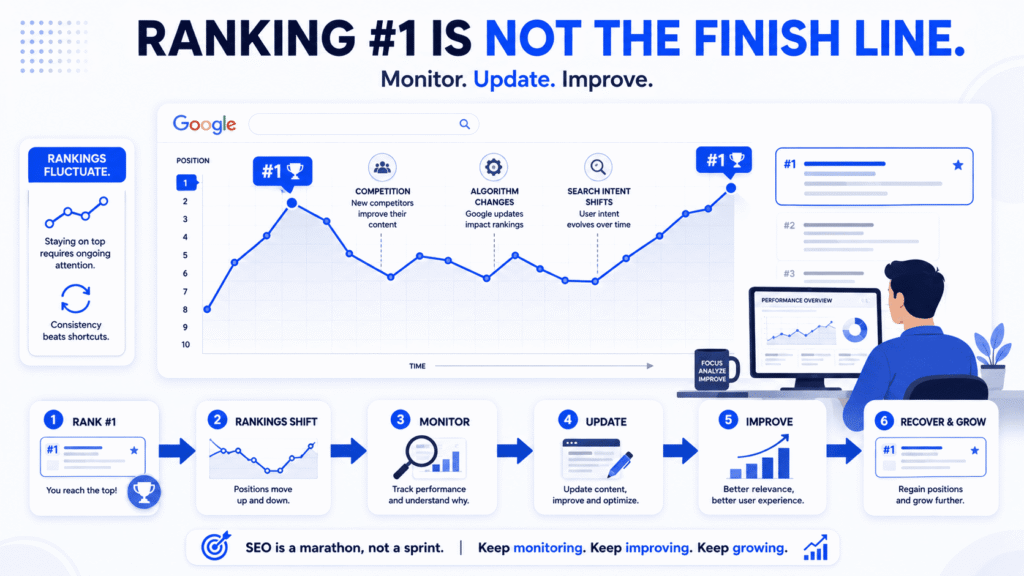
Reaching the top spot feels like a finish line, but rankings shift constantly. Competitors publish new content, Google updates its algorithm, and search intent for a topic can change over time. None of that means something went wrong.
Keeping an eye on performance helps catch drops early, before they become a bigger problem. Anyone wanting to stay on top of this should check out how to track your SEO progress, which covers exactly what to monitor.
Myth – Social Shares Directly Boost Rankings
| Term | Meaning |
| Social Signals | Social signals refer to likes, shares, and comments a piece of content receives on social media platforms. |
Social shares feel like they should help rankings, since more visibility seems like it would matter to Google. In reality, social signals are not a confirmed direct ranking factor.
What social shares can do is bring in extra traffic and, occasionally, lead to other websites linking to the content, which does help SEO indirectly. Sharing content on social media is still worthwhile, just not as a shortcut to higher rankings.
Myth – Exact Match Domains Guarantee Better Rankings
| Term | Meaning |
| Exact Match Domain | An exact match domain is a website address that contains the exact keyword someone might search for, such as bestcoffeemakers.com for a coffee maker review site. |
This myth used to hold more truth than it does now. Exact match domains once had a noticeable ranking advantage, which led to a flood of low-quality websites built purely around keyword-stuffed domain names.
Google adjusted for this, and having a keyword in a domain name no longer guarantees anything. A memorable, brand-friendly domain name that reflects the blog’s identity is generally a smarter long-term choice than chasing a keyword-based one.
Important FAQs
Is SEO still worth learning with AI search growing?
Yes. AI search still depends on well-written, trustworthy content, so understanding SEO fundamentals remains valuable.
Do backlinks matter if just starting out?
Backlinks help, but content quality and relevance matter more early on. Backlinks become more useful once a site has solid content in place.
Will rankings drop from not publishing every day?
No. Consistency matters far more than frequency. A realistic, sustainable schedule works better than rushed daily posts.
Is it possible to do SEO without paying for expensive tools?
Yes. Free tools like Google Search Console provide enough data for most beginner blogs to get started and grow.
Does domain authority affect small, new blogs?
It is just one estimate among many factors, not something Google directly uses. Content quality and search intent matter more.
Why do SEO experts give different advice about the same topic?
SEO changes over time, and not everyone updates their advice at the same pace. That is exactly why so many myths stick around.
What to Do Next
Reading about these myths is one thing. Checking a blog against them is what actually makes a difference. Pick just one myth from this post that felt familiar, and take five minutes to check how it applies to an existing blog. A great place to start is running through how to do a basic SEO audit, which walks through exactly what to look for.