You’ve nailed down your niche. You know exactly what you want to write about.
Then you open a domain search tool, type in your first idea, and the word “taken” stares back at you. You try another. Taken.
This guide skips the hobbyist advice about picking something catchy. It’s the next step after how to start a blog for beginners — locking down the name that carries your expertise online.
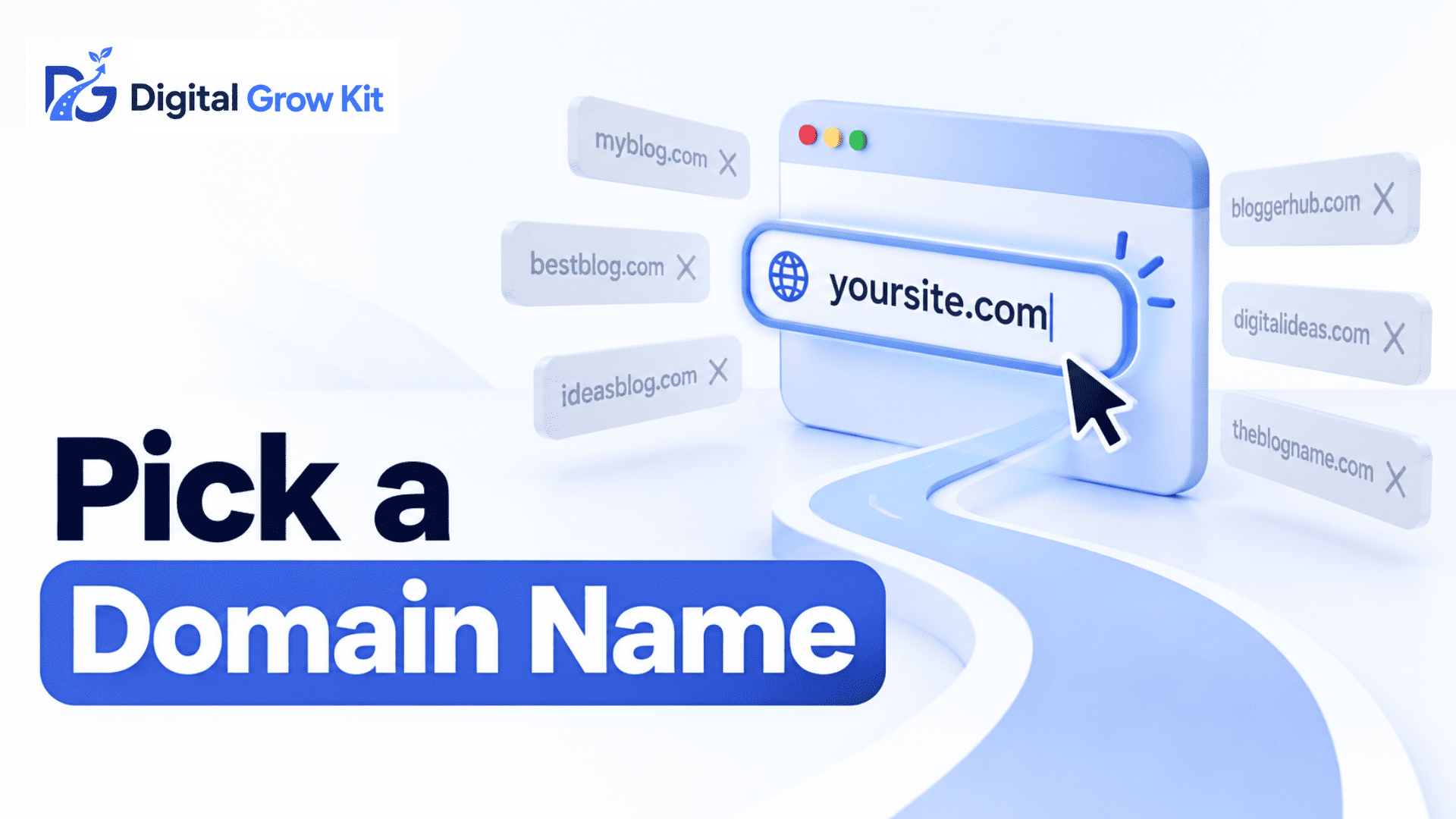
What Is a Domain Name, and Why Does It Matter for Your Blog?
| Term | Meaning |
| Domain name | The web address people type to find your site — like digitalgrowkit.com — and the name Google shows in search results. |
A domain name is your blog’s address on the internet. If you’re still fuzzy on what a blog even needs, check out what a blog actually is first.
Someone types your address into their browser, and Google displays it right next to your page title in search results.
Here’s why it matters: your domain is often the first thing a potential client sees before reading a single word you’ve written.
It shapes whether they trust you enough to click. A confusing domain can undo weeks of good content before anyone even reaches it.
Picture two blogs on the same topic. One has a clean, memorable domain. One has a string of numbers and hyphens.
Which one feels more credible? The domain does its work before your content gets the chance to.
It’s also a long-term decision. Change your domain later, and you rebuild your search rankings from scratch.
Get it right at the start, and you save yourself a lot of rework down the line.
What Makes a Domain Name Good or Bad?
| Term | Meaning |
| Brandable domain | A domain name that’s easy to say, spell, and remember — the kind someone can repeat back to a friend without checking their notes. |
A brandable domain does a few things at once. It stays short, and you can say it out loud without stumbling.
People can spell it correctly after hearing it just once. And it hints at what you do, without cramming in every keyword you can think of.
Bad domain names usually fail on one point, not all of them. Some turn out memorable but impossible to spell.
Others land accurate but forgettable — three generic words strung together that nobody recalls an hour later.
Numbers and hyphens trip up more blogs than anything else. They show up because someone already took the obvious name.
Try telling a colleague “my-fitness-coach-hyphen-pro” out loud. It won’t survive the conversation.
| Good example | Why it works | Bad example | Why it struggles |
| coachwithease.com | Short, easy to say, easy to spell | fitness-coach-pro2.com | Hyphens and numbers break memorability |
| clearnutritionguide.com | Clear about the topic, no tricks | nutritiongurusite123.com | Numbers feel random and hard to recall |
| buildwithclara.com | Personal, simple, brandable | buildingwebsitesforclients.net | Too long, hard to say in one breath |
Should You Use Your Name, Your Niche, or a Brand Name?
| Term | Meaning |
| Niche-based domain | A domain name built around your topic or specialty rather than your personal name — for example, a name describing what you help people do. |
Three common routes exist here, and each suits a different kind of professional.
Using your own name works well when you’re the face of your expertise — a consultant, a coach, someone whose personal reputation drives the business.
A niche-based domain works better when the topic matters more than the individual. Still deciding your angle? Learn how to choose a blog niche before you lock in a name.
Not sure what a “niche” even means in this context? This explains blogging niches simply.
A brand name — invented, distinct from both your name and your niche — gives you the most flexibility to grow.
It takes more effort to make memorable since it doesn’t explain itself. But it scales well if you’re planning something bigger than one blog.
None of these wins universally. Your pick depends on the reputation you’re building.
| Domain type | Pros | Cons |
| Personal name | Builds your individual reputation; simple to explain | Limits growth if you bring on other contributors |
| Niche name | Clear to searchers; scales beyond one person | Less personal; harder to pivot topics later |
| Brand name | Most flexible long-term; can grow into new areas | Takes more work to make memorable from scratch |
Which Domain Extension Should You Choose — .com, .in, .co, or Something Else?
| Term | Meaning |
| Domain extension (TLD) | The part after the dot in a web address, like .com or .co — short for “top-level domain.” |
The domain extension, or TLD, is everything after the dot. Dozens exist now, but a professional blog usually comes down to a handful of options.
.com remains the safest default. Hear a domain spoken aloud, and most people type “.com” without thinking twice.
Country-specific extensions can work if your audience is entirely local. But for a global, English-speaking audience, they can quietly limit how far your content travels.
Newer extensions, built around blogging or professional services, only make sense once .com is off the table.
| Extension | Best use case |
| .com | Default choice for most professional blogs and global audiences |
| Country-specific (e.g. .in, .us) | Best when your audience is entirely local to that country |
| .co | A backup when .com is taken and you want something close |
| Niche extensions (e.g. blog, pro) | Worth using only as a last option, once .com isn’t available |
How Do You Check If a Domain Name Is Available?
| Term | Meaning |
| Domain availability check | The process of confirming whether a specific web address is already registered by someone else or free for you to buy. |
A domain availability check takes minutes, but doing it properly means a few extra steps most people skip.
Start with a domain search tool from any registrar. Type in your top choice and see what comes back.
If it’s available, don’t register it yet — check the next two items first.
Search the exact name on every social platform you plan to use. A matching domain and handle make your brand easier to find consistently.
Run a quick search of the name itself, not just the domain. If a known business already uses it, reconsider to avoid a trademark conflict.
Only once all three checks clear should you register it.
What Should You Avoid When Picking a Domain Name?
| Term | Meaning |
| Trademark conflict | A situation where a name you want to use is already legally protected by another business, which can force you to change it later. |
A few mistakes trip up beginners often enough to call out directly.
Avoid names that closely resemble an existing, well-known business in your field, even when the domain is technically available.
This risks a legal trademark conflict down the line. Rebuilding a blog under a new name is painful once readers know the old one.
Avoid names you can’t say out loud with confidence. That includes clever wordplay that only makes sense once you write it down.
Avoid names that run too long. Anything you can’t fit into a short sentence becomes a burden to type or repeat.
And avoid copying a close competitor’s name with a minor tweak. It usually creates confusion instead of borrowed trust.
Where Should You Buy Your Domain Name?
| Term | Meaning |
| Domain registrar | A company authorized to sell and manage domain name registrations, where you officially purchase and renew your domain. |
Once your name passes every check above, buy it through a domain registrar.
Weigh three things first: the renewal price (not just the first-year discount), whether privacy protection comes included, and how straightforward the dashboard feels.
Some registrars bundle hosting with the domain purchase. This simplifies setup, especially early on. Working with a tight budget? See if you can start a blog with no money before committing to a paid bundle.
Buy separately instead, and you gain more flexibility — though you’ll manage two accounts.
| Approach | Cost | Convenience |
| Domain + hosting together | Often discounted as a bundle | One account, simpler setup |
| Domain and hosting separate | Can be cheaper long-term with the right combination | More control, but two accounts to manage |
For professionals who want a straightforward starting point, Hostinger offers a solid option — register a domain and set up hosting in one place.
Digital Grow Kit’s recommendations follow the platform’s own testing standards for beginner-friendliness and reliability.
Important FAQs
Can you change your blog’s domain name later?
Yes, but it comes at a cost. You lose some search ranking progress and have to update every existing link.
Do you need to buy hosting and your domain from the same company?
No. Plenty of professionals split them across two companies. Buying together just simplifies your first setup.
Is a free domain name good enough for a blog?
Free domains usually come with a subdomain attached, like yourname.wordpress.com. Curious what that route really involves? Here’s how to start a blog for free.
How much does a domain name usually cost?
Most standard domain names cost a modest amount per year, often less than a coffee subscription. Check the renewal cost upfront to avoid surprises.
Should your domain name include your main keyword?
It can help slightly, but it’s not essential. A clear, brandable name paired with strong content usually wins.
What’s the difference between a domain name and a website?
A domain name is the address. A website is everything that lives at that address — you set up and manage them separately.