Ever click “read more” on a website without even thinking about it? That little bit of clickable text has a name — anchor text — and it plays a bigger role in SEO than most beginners realize. If every SEO guide you’ve read so far skipped straight to advanced tips and left you confused, this one starts from zero. No assumptions, no jargon left unexplained.
What Is Anchor Text? (In Plain English)
| Term | Meaning |
| Anchor text | The clickable words inside a link, usually shown in a different color or underlined. It’s what someone actually clicks on to go to another page. |
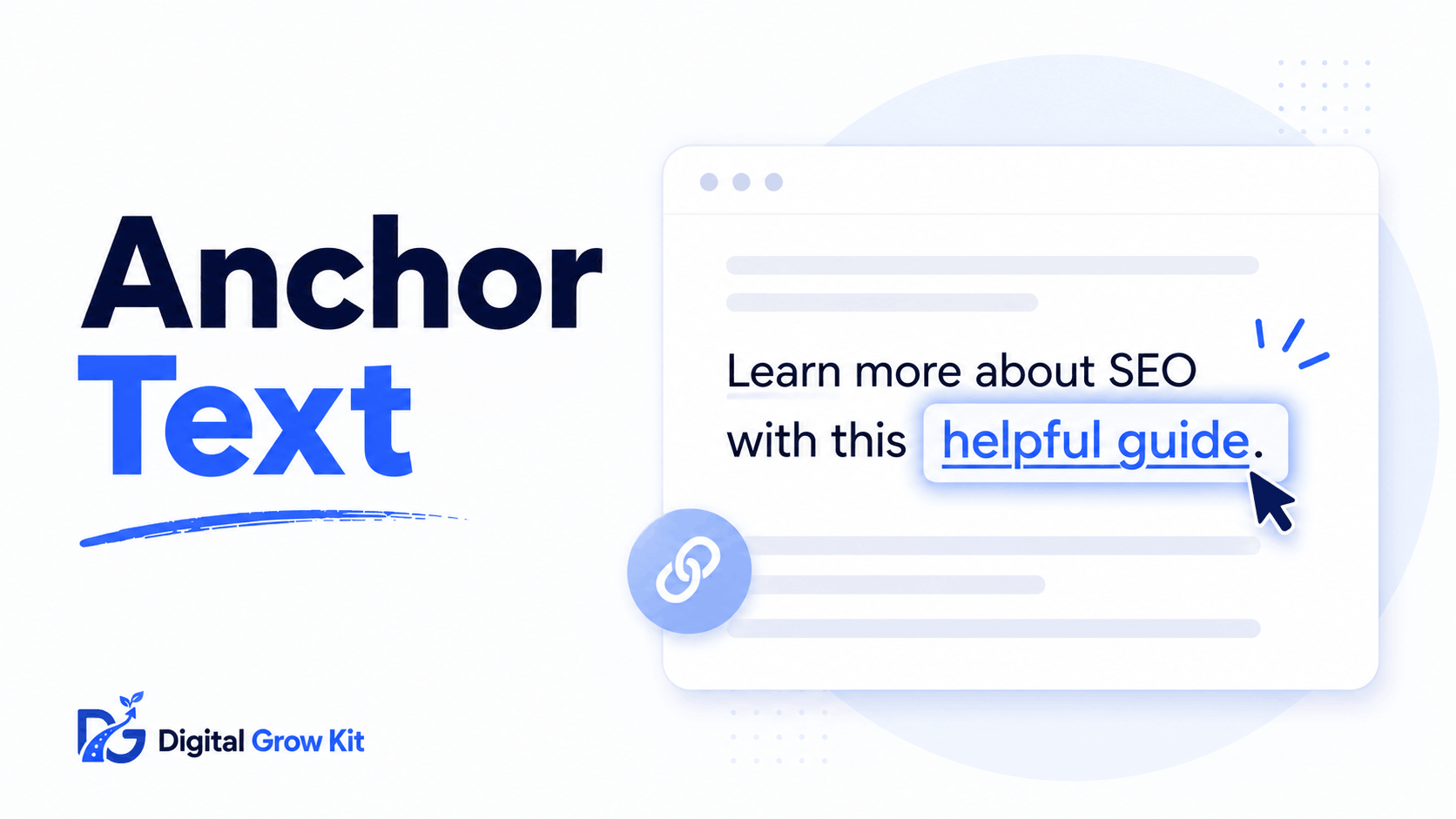
Here’s the thing — anchor text is something you see every single day, even if you never knew its name. Any time you read a sentence online and one part of it is colored blue or underlined, that clickable part is anchor text.
For example, in a sentence like “check out this free keyword tool,” the words “free keyword tool” would be the anchor text if they were turned into a clickable link. The rest of the sentence stays as normal text. Simple as that.
So what does that mean for you? Anchor text isn’t some hidden technical setting. It’s just the words you choose to make clickable whenever you add a link to your content.
Where Does Anchor Text Show Up?
| Term | Meaning |
| Internal link | A link that connects one page on your own website to another page on your own website. |
Anchor text shows up in more places than most beginners expect. It appears inside your blog posts whenever you link one article to another — that’s called an internal link. It also shows up when other websites link back to your content, which is known as a backlink.
Don’t worry — this is simpler than it sounds. Anchor text also lives in smaller places, like your website’s menu bar or footer. Any time you see clickable text anywhere on a site, that’s anchor text doing its job.
Why Does Anchor Text Matter for SEO?
| Term | Meaning |
| Relevance signal | A clue that tells Google what a page is about, based on things like the words used around and inside a link. |
Anchor text matters because Google reads it as a clue about what the linked page is actually about. Think of it like a short label attached to every link. When that label matches the content on the other end, it helps Google understand and rank the page more accurately.
This connects closely to two things covered in on-page SEO basics — how your own site is structured — and to how backlinks work, where other websites vouch for your content through links pointing to it. Anchor text is the thread that ties both of those together.
Google also uses anchor text patterns as part of how it evaluates a site’s overall trust and domain authority, which is a score that reflects how credible and established a website appears to search engines. Natural, varied anchor text tends to look more trustworthy than the same exact phrase repeated over and over.
The Main Types of Anchor Text (With Examples)
| Term | Meaning |
| Anchor text type | A category that describes what kind of words are used as the clickable link text. |
Not all anchor text looks the same, and knowing the different types makes it much easier to use them naturally.
| Type | Example | When to Use It |
| Exact Match | “keyword research tools” | Sparingly — only when it fits naturally |
| Partial Match | “tools for researching keywords” | Often — reads more naturally |
| Branded | “Digital Grow Kit” | When linking to your own brand or homepage |
| Generic | “click here,” “read more” | Occasionally — avoid overusing |
| Naked URL | “digitalgrowkit.com/topic” | When sharing a raw link, like in a resource list |
| Image | Alt text of a linked image | When the link is attached to a picture instead of text |
Mixing these types is where most beginners get it wrong. Using the exact same phrase every time might feel safe, but it actually looks unnatural to Google — and to real readers too.
How to Use Anchor Text Naturally (Without Overdoing It)
| Term | Meaning |
| Anchor text over-optimization | Using the same exact keyword phrase as anchor text too many times, which can look spammy to search engines. |
A good rule to follow: anchor text should always feel like a normal part of the sentence, not something bolted on. If a sentence sounds awkward once the link is removed, it probably needs a rewrite.
Here’s a simple way to keep things natural. Vary the wording every time. Instead of linking the exact same phrase across every post, describe the destination page in a few different ways. For deeper strategies on this, building links the right way covers how to approach this at a larger scale, beyond just individual posts.
A helpful mental check: read the sentence out loud. If it still makes sense and flows naturally with the anchor text included, it’s doing its job.
Common Anchor Text Mistakes Beginners Make
Every beginner makes a few of these early on — the goal is catching them before they become a habit.
- Repeating the exact keyword every time. This can make a site look like it’s trying to manipulate search rankings instead of genuinely helping readers.
- Using vague anchors like “click here” too often. These don’t tell Google or readers anything about the linked page.
- Linking irrelevant pages just to add more links. A link only helps if it actually connects to something useful and related.
- Forgetting to check that the link even works. A broken link with great anchor text still hurts the reader’s experience.
Avoiding these four mistakes puts a blog ahead of a large share of beginner sites right away.
Anchor Text for Internal Links vs Backlinks
| Term | Meaning |
| Backlink | A link from another website that points back to your website. |
Internal links and backlinks both use anchor text, but they serve slightly different purposes. Internal links help readers (and Google) move around a single website smoothly, connecting related topics together. Backlinks, on the other hand, act more like a recommendation from another site, telling Google “this page is worth checking out.”
Because of that difference, internal link anchor text can be a little more flexible and descriptive, since it’s fully within your control. Backlink anchor text depends on how other websites choose to link, though reaching out with a suggested anchor phrase can still help guide it.
Important FAQs
Is anchor text the same as a hyperlink?
Not exactly. A hyperlink is the entire clickable connection to another page. Anchor text is just the visible words that make up that link.
Can too much exact-match anchor text hurt SEO?
Yes. Repeating the same exact keyword phrase as anchor text too often can look unnatural to search engines and may hurt rankings over time.
Does anchor text color or underline matter for SEO?
Not directly. The visual style matters more for readability and user experience than for search rankings.
Should every link use different anchor text?
Not necessarily every single one, but variety across a site is healthier than repeating the same phrase constantly.
What’s the safest anchor text to use for backlinks?
Branded anchor text (like a site or brand name) and natural partial-match phrases tend to be the safest, lowest-risk options.
Does anchor text matter for images?
Yes. When an image is used as a link, its alt text often acts as the anchor text, so it should still describe the destination clearly.
What to Do Next
Anchor text might seem like a small detail, but small details add up across an entire website. A good next step is opening a few published posts and checking whether the internal links use natural, varied anchor text — or whether the same phrase keeps showing up. For a deeper look at building links the right way, link building for beginners is a solid next read.