Chasing backlinks and still not moving up in Google? That’s usually because off-page SEO is bigger than links alone — and most beginner guides never explain the rest. Digital Grow Kit is going to walk through the whole picture, from zero, so nothing feels like a guess.
What Does “Off-Page SEO” Actually Mean?
| Term | Meaning |
| Off-page SEO | Anything you do away from your own website to help Google trust it and rank it higher, like earning links, mentions, and reviews elsewhere online. |
Here’s the thing — off-page SEO covers everything that happens outside your website that still affects how well it ranks. Think of it as your site’s reputation out in the wider world.
Google can’t just take your word for it that your blog is helpful. It looks for outside signals to confirm that. Other people linking to you, talking about you, or recommending you all count as those signals.
This is different from what you control directly on your own pages. That part has its own name, and it’s worth understanding the difference clearly.
Off-Page SEO vs On-Page SEO — What’s the Difference?
| Term | Meaning |
| On-page SEO | The parts of SEO you control directly on your own website, like your content, titles, and page structure. |
So what does that mean for you? On-page SEO is everything happening inside your website. Off-page SEO is everything happening outside it. Both matter, but they work in different ways.
| Factor | On-Page SEO | Off-Page SEO |
| Where it happens | On your own website | Outside your website |
| What it includes | Content, titles, headings, page speed | Backlinks, mentions, reviews, social signals |
| Who controls it | You, fully | Partly you, partly other people and sites |
| Main goal | Help Google understand your page | Help Google trust your page |
A great post that nobody else links to or talks about can still struggle to rank. That’s why off-page SEO matters just as much as writing good content in the first place.
Why Backlinks Aren’t the Whole Story
| Term | Meaning |
| Backlinks | Links from other websites that point to your website, acting like a vote of confidence from one site to another. |
Don’t worry — this is simpler than it sounds. Backlinks are the most talked-about part of off-page SEO, and for good reason. When another site links to yours, it tells Google that someone out there trusts your content enough to point their readers toward it.
But here’s what a lot of beginner content skips over: backlinks are just one signal among several. Google also looks at how your brand shows up across the internet in other ways, not just through links.
That means focusing only on links can leave you missing easier, faster wins sitting right in front of you.
What Other Signals Count as Off-Page SEO?
| Term | Meaning |
| Off-page signal | Any trust or authority signal that happens somewhere other than your own website. |
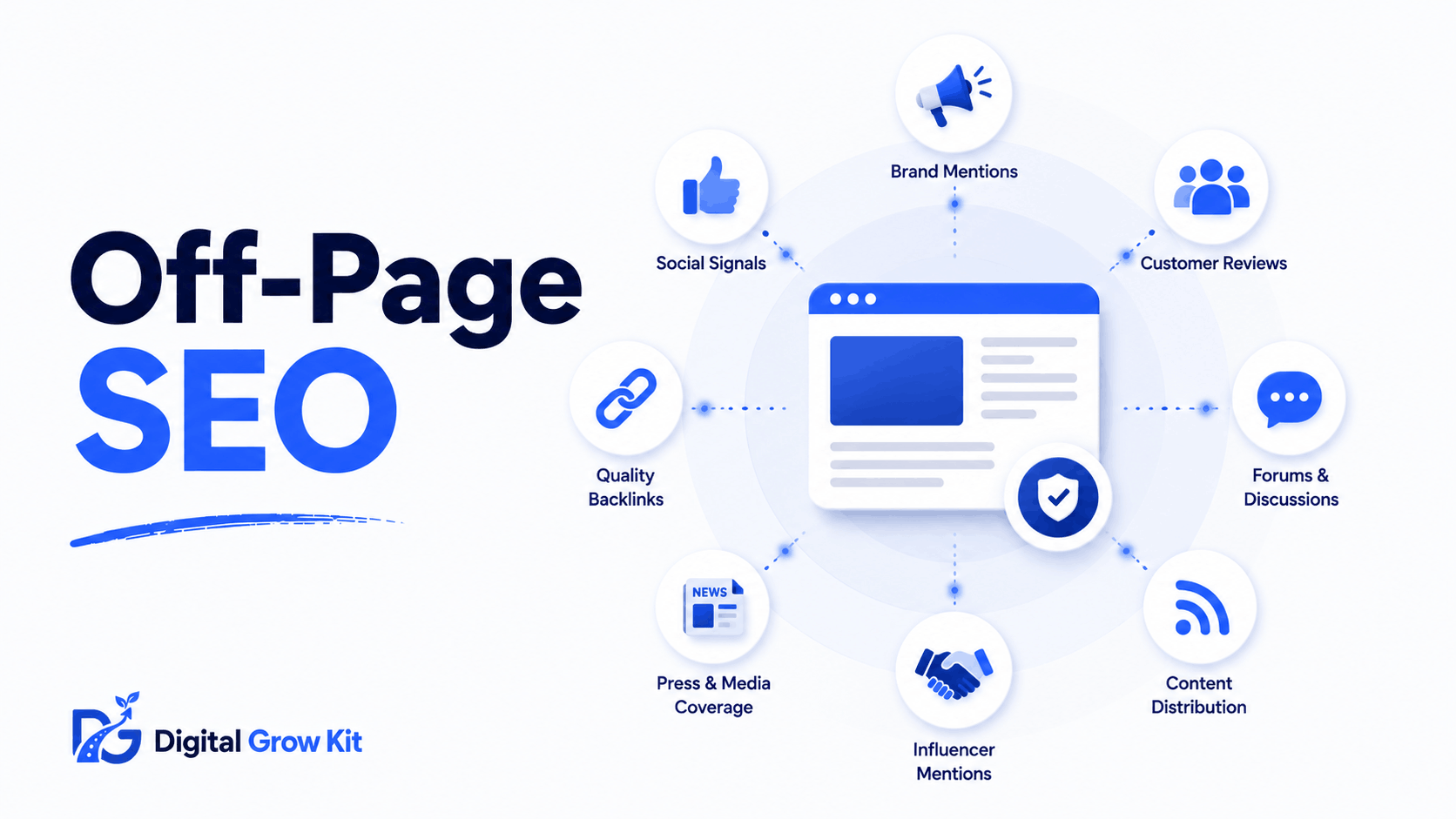
Let me explain. Beyond links, Google pays attention to a handful of other signals when deciding how much to trust a site.
| Signal | What It Means |
| Brand mentions | Your blog or business name mentioned online, even without a link attached |
| Social signals | Shares, comments, and engagement your content gets on social platforms |
| Reviews | What people say about your blog, product, or service on review sites |
| Guest posting | Writing content for other websites in your niche, usually with a link back to your site |
| Community presence | Being active and helpful on forums or online communities related to your topic |
None of these need to feel overwhelming. Most beginners can realistically work on two or three of these at a time, and that’s genuinely enough to start.
Brand mentions are worth calling out specifically, since they’re the most overlooked. Even when someone mentions your blog by name without linking to it, Google can still pick up on that mention as a small trust signal.
Does Social Media Actually Help SEO?
| Term | Meaning |
| Social signal | Any interaction your content receives on social media, like shares, likes, or comments. |
This is a question almost every beginner asks eventually, and it deserves a straight answer. Social shares are not a direct Google ranking factor. Posting on social media does not, by itself, push your blog post up in search results.
That said, social media still helps in an indirect way. More people seeing your post means more chances someone links to it, mentions it, or shares it on their own blog. Those secondary effects are what actually move the needle for SEO.
So social media is worth doing, but it should be treated as a discovery tool, not a shortcut around real off-page work.
How Do You Start Working on Off-Page SEO as a Beginner?
| Term | Meaning |
| Off-page SEO strategy | The ongoing set of actions you take outside your website to build trust and authority over time. |
Here’s a simple starting point that doesn’t require any technical skill or budget.
- Get listed where it makes sense. Add your blog to relevant directories or communities in your niche so it becomes easier to find.
- Comment and engage genuinely. Join forums or groups related to your topic and contribute real answers, not spam.
- Reach out for guest posts. Offer to write a helpful article for another blog in your niche in exchange for a link back to yours.
- Ask happy readers for a mention or review. A short, honest mention from someone who liked your content carries real weight.
- Keep an eye on your progress. Use Google Search Console to see which pages are picking up outside attention over time.
None of these need to happen all at once. Off-page SEO builds slowly, and steady small actions beat one big rushed push every time.
Once mentions and links start coming in naturally, it’s worth learning how to build on that momentum with a proper plan, which is exactly what link building for beginners covers next.
Your site’s overall domain authority tends to grow as these off-page signals add up over time, so don’t expect it to jump overnight. That’s completely normal.
Important FAQs
Is off-page SEO the same as link building?
Not exactly. Link building is one part of off-page SEO, but off-page SEO also includes brand mentions, reviews, social signals, and community presence.
Can you rank well with only off-page SEO and no on-page SEO?
Not really. Both need to work together. Strong off-page signals won’t save a page that’s poorly written or hard to understand.
Do social media likes and shares directly affect Google rankings?
No, not directly. They help indirectly by getting your content in front of more people who might link to or mention it.
How long does it take to see results from off-page SEO?
It varies, but most beginners should expect gradual progress over several months rather than instant results. Off-page trust builds slowly and steadily.
What’s the easiest off-page SEO strategy for a brand-new blog?
Getting involved in relevant online communities and offering genuinely helpful answers is one of the simplest ways to start earning attention and mentions.
Is guest posting still worth doing?
Yes, as long as it’s done on relevant, genuine sites rather than low-quality ones purely for a link. Quality matters more than quantity here.
What to Do Next
Off-page SEO can feel like a lot at first, but it doesn’t need to be complicated. Pick one small action from the list above — maybe joining one relevant community or checking Google Search Console for existing mentions — and start there. Everything else can build from that one step.